

Like Water, Like Silk: The Bride's Guide to Liquid Satin Wedding Dresses
There is a particular kind of bridal magic that belongs only to liquid silk and its close companion, duchess satin — the way the fabric catches light as the bride moves, pooling and rippling like still water disturbed by the gentlest current. It is an aesthetic rooted in old Hollywood glamour, in the bias-cut masterpieces that swept 1930s silver screens, and it has never, not once, felt anything less than completely timeless.
If you have been searching for a liquid silk wedding dress, you already know the feeling you're chasing: effortless, sculptural, quietly sensual. Here is everything you need to know about the silhouette, the fabrics, and the designers who do it best — many of them available as pre-owned and sample gowns through Kleinfeld Again.
What Makes a Gown Look "Liquid"?
The term "liquid silk" describes the visual and tactile quality of a fabric that appears to flow. True silk charmeuse, silk crepe, and silk-backed satin all achieve this effect, but many brides are surprised to discover that high-quality duchess satin and silk-faced satin can look equally fluid when cut correctly. The secret is in the construction: a true satin long wedding dress in this family is almost always cut on the bias — at a 45-degree angle to the grain — which allows the fabric to drape over curves rather than sitting rigidly against them.
The result is a silhouette that reads as fit-and-flare or column depending on the body, skimming the waist and hips before releasing into a gentle sweep or dramatic satin wedding dress with train. It is impossibly flattering on tall, lean figures, and with the right construction, equally beautiful on hourglass and curvy brides — the bias cut actually distributes fabric evenly across the fullest points of the body.

Romona Keveza is one of the foremost American designers working in this tradition. Her gowns are almost exclusively crafted in imported Italian and French fabrics — silk charmeuse, silk organza, Venetian lace — and her cut honors the body with the precision of a sculptor. The L2421 is a masterclass in restrained luxury: the kind of satin long wedding dress that needs nothing added to it because the fabric is the entire statement.
The 1930s Influence — and Why It Still Resonates
The 1930s satin wedding dress silhouette — think Madeleine Vionnet and Jean Harlow — is the original blueprint for everything brides love about liquid silk today. Low, draped backs. Barely-there straps. A skirt that grazes the floor and fans into a modest train. The power of this aesthetic is its confidence: it asks for no embellishment because it relies entirely on the interplay of light and shadow across moving fabric.
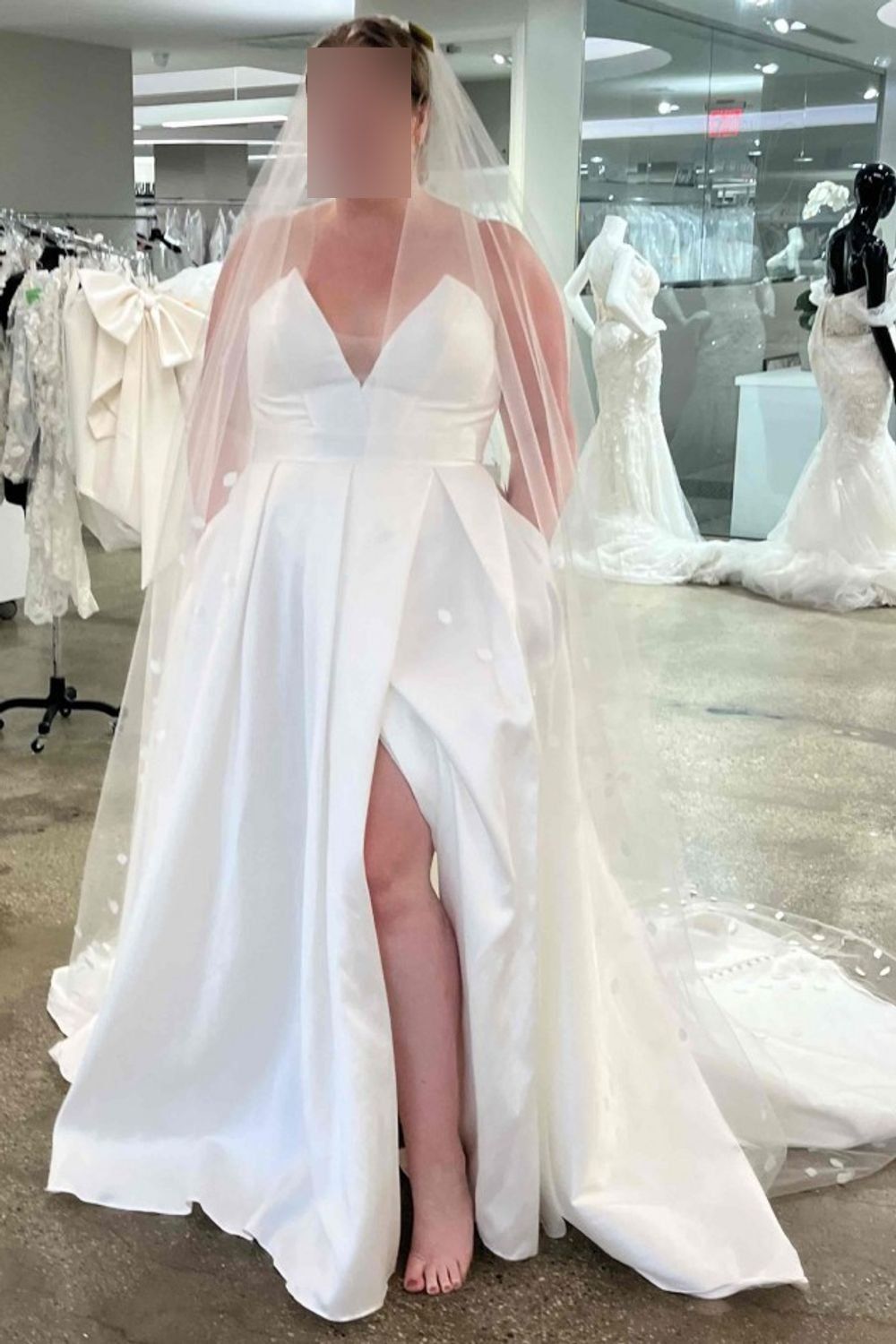
Contemporary designers have reinterpreted this idiom in fresh ways. Some have added a sculptural satin wedding dress with bow on back — the oversized bow has emerged as one of the defining bridal details of recent years, bringing a playful, almost editorial counterpoint to the gown's fluid formality. Others have introduced long, draped satin sleeves for wedding dress silhouettes that echo the covered glamour of 1930s and 1940s Hollywood.

$3,300


$2,150
Elizabeth Fillmore's Vesper is precisely the kind of gown that embodies this 1930s-inflected aesthetic — a draped, liquid silhouette with the moody sensibility of a film noir heroine. Costarellos' THEODORA brings a modern Grecian minimalism, its satin face catching candlelight with quiet intensity. And Liz Martinez's Eugenie offers the full drama of a satin wedding dress with train, elongating the figure beautifully — Martinez is known for her mastery of fabrication and her particularly Colombian-influenced romanticism.
On the Question of Color: The Pink Satin Wedding Dress
While ivory and champagne remain the classics for liquid silk gowns, the pink satin wedding dress has become a genuine bridal moment. Blush and ballet pink in satin are extraordinary — the warmth of the color amplifies the warmth of the fabric's sheen, creating a glow that feels genuinely otherworldly against most skin tones. From the palest barely-there blush to a more confident dusty rose, pink satin signals a bride who knows exactly who she is and is not apologizing for it.

Tony Ward's Violin lives up to its name — the gown is shaped like a musical instrument, its contours precisely engineered to create a figure that is both dramatic and deeply feminine. Ward, the Lebanese couturier whose bridal work has dressed some of the world's most celebrated women, works in luxurious satins that behave like liquid under studio lighting. This is the kind of gown that photographs in a way that stops you mid-scroll.
The Midi Satin Wedding Dress — A Modern Counterpoint
Not every bride wants a train. The midi satin wedding dress — falling at the calf or just below the knee — is having a genuine cultural moment, particularly for civil ceremonies, intimate weddings, and brides who simply want freedom of movement. In satin, the midi length is surprisingly sophisticated: the fabric's natural weight creates a hem that swings with intention, and the shorter silhouette allows footwear (an architectural heel, a sculptural sandal) to become part of the story.
Why Pre-Owned Is the Smartest Way to Wear Liquid Silk
Here is something seasoned bridal stylists will tell you: fabric quality is everything in a liquid silk or satin gown, and truly exceptional fabric only exists at a certain price point. The gowns that drape most beautifully, that photograph most luminously, that feel most extraordinary against the skin — those are designer gowns, made in European mills, constructed by artisans who have spent decades understanding how fabric behaves.
At Kleinfeld Again, that caliber of gown — Romona Keveza, Costarellos, Elizabeth Fillmore, Liz Martinez, Tony Ward — is available as pre-owned, sample, or never-worn dresses at a fraction of the original retail price. A liquid silk wedding dress is one of the most photographed objects in a bride's life. It deserves to be the real thing.
Explore Fit & Flare Wedding Dresses →